Top 10 Workstation Furniture Suppliers in China?
Choosing a Workstation Furniture supplier in China involves more than comparing catalogue prices. Buyers need to assess product quality, customization options, production capacity, communication, and delivery support. A workstation may look polished in a showroom, yet perform differently after months of daily use. Check frame stability, edge finishing, cable management, drawer movement, and the feel of the work surface.
This guide introduces ten notable suppliers for buyers exploring China’s office furniture market. The selection is intended as a practical starting point, not a universal ranking; supplier capabilities and fit can change by project. Compare each company’s product range, manufacturing information, quality-control practices, and experience with orders similar to yours. Request current specifications and samples when possible. A close-up of a desk joint or a sample finish can reveal details a product photo misses.
Ask how the supplier handles design revisions, packaging, after-sales questions, and production updates. Clear answers matter. So does consistency. A low quotation may leave important details unclear, while a higher price does not automatically guarantee better service. That deserves a second look. Use the profiles below to build a shortlist, then verify claims directly and compare written proposals against your actual requirements. The right partner should make those requirements easier to discuss, not harder. Companies differ, and this overview cannot replace project-specific checks.
Workstation Furniture in China: Product Scope, Types, and Applications
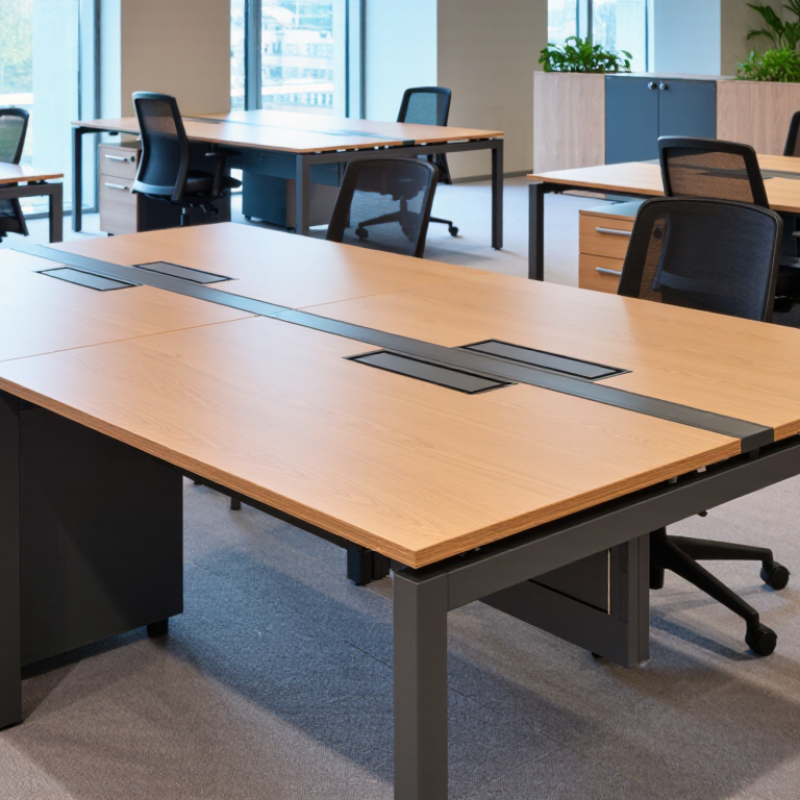
Workstation furniture in China covers more than desks and chairs. Typical product ranges include single desks, shared benching systems, height-adjustable tables, task chairs, mobile pedestals, and modesty panels. Modular frames let teams add or rearrange workstations as headcount changes. Cable trays, monitor arms, and desk screens support cleaner, more focused work areas. Small details matter.
Materials and construction vary by price and use. Common choices include steel frames, engineered wood tops, laminate surfaces, and mesh-backed chairs. Buyers should check dimensions, load capacity, adjustment range, edge finishing, and replacement-part availability. Product descriptions can be broad, so written specifications and sample inspections help clarify what is actually supplied.
Applications range from compact home offices to corporate floors, call centers, design studios, and training rooms. Open-plan teams may need shared benches with acoustic screens, while private tasks often suit individual desks with storage. Technical departments may require larger work surfaces for drawings or equipment. A showroom arrangement can look convincing, yet fit poorly in a real room. Measure walkways, power access, and chair clearance before confirming quantities. Even careful planning can miss a practical detail.
China Supplier Landscape: Market Size, Output, and Export Indicators
Top 10 Workstation Furniture Suppliers in China?
China’s workstation furniture landscape spans large factories, regional manufacturers, and smaller specialists. Market size estimates can differ because reports may group desks, office seating, storage, and complete workstations differently. Treat any single figure with care.
To assess the supplier base, compare several indicators: domestic market value, reported furniture output, factory capacity, and export value or volume. Export data can reveal demand beyond China, but product classifications may combine workstation desks with other furniture. Check reporting periods, units, and product definitions before comparing figures. A rising export value alone does not prove higher output; prices and product mix can change. The data is not always tidy.
Tips: Ask suppliers for recent production records, export documentation, and capacity details for the exact product category. Compare samples, packaging, and lead times against their stated output. A supplier’s scale matters, but it is only useful if the figures match your order.
Top 10 Workstation Furniture Suppliers in China? - China Supplier Landscape: Market Size, Output, and Export Indicators
Data note: China does not publish a dedicated national market-size, output, or supplier-ranking series for workstation furniture. The table below uses official statistical and customs reporting scopes and identifies where workstation-specific figures are not separately available. No company or brand names are included.
| No. | Indicator | Publicly reportable scope | Workstation-specific data status | Source / interpretation |
|---|---|---|---|---|
| 1 | Market size | Furniture manufacturing and furniture-market measures may be reported at broader industry level. | No standalone national market-size figure identified for workstation furniture. | National Bureau of Statistics (NBS) industry classifications cover broader categories; these should not be treated as workstation-only market value. |
| 2 | Furniture-industry operating revenue | NBS publishes manufacturing indicators for enterprises above designated size in relevant industry releases. | Not broken out as workstation-furniture revenue. | The enterprise-size coverage and industry scope should be checked before using the figure as a market-size proxy. |
| 3 | Workstation furniture output | Official manufacturing output is reported under broader product or industry categories. | No separate nationwide output series for workstation systems identified. | Desk systems may include desks, screens, storage, frames, and accessories, which are not necessarily counted together in one official category. |
| 4 | Furniture manufacturing output | Available through broader official furniture-industry or product reporting. | A broader indicator, not a direct measure of workstation production. | NBS statistical releases are the reference for national manufacturing indicators; category definitions should accompany any quoted figure. |
| 5 | Exports: wooden office furniture | HS 940330: wooden furniture of a kind used in offices. | Customs trade data can be queried for this tariff line; it is not limited to workstation desks. | China Customs or UN Comtrade data can be used for trade values and quantities by year and destination. |
| 6 | Exports: metal office furniture | HS 940310: metal furniture of a kind used in offices. | Includes office furniture beyond workstation systems; material-specific trade data do not identify desk configurations. | Use the applicable customs tariff schedule and reporting year when comparing export values. |
| 7 | Exports: other office-furniture materials | Other relevant furniture tariff lines may cover products made from other materials or broader furniture categories. | There is no single tariff line that captures every workstation system and material combination. | Classification depends on product material, construction, and customs rules; tariff codes should be checked product by product. |
| 8 | Export destination coverage | Customs datasets provide trade flows by destination for specified tariff codes and periods. | Destination-level totals do not reveal which suppliers produced the goods. | Compare the same HS code, year, trade basis, and reporting source when assessing destination markets. |
| 9 | Top-10 supplier ranking | A ranking requires a defined measure, such as verified workstation revenue, output, or export sales. | No authoritative public national ranking specific to workstation-furniture suppliers identified. | Company-level rankings should not be inferred from broad industry totals or customs data that do not identify producers. |
| 10 | Supplier due-diligence indicators | Production capacity, product mix, certifications, export experience, and audit results require supplier-level verification. | Not available as a complete, standardized national dataset. | Validate through current factory records, product documentation, independent audits, and shipment or customer references. |
Sources to consult: China National Bureau of Statistics (NBS) industry releases; China Customs statistics; and UN Comtrade tariff-line trade data. Figures from these sources describe their stated categories and should not be presented as workstation-only data unless the underlying classification supports that interpretation.
Ergonomic and Safety Benchmarks: ISO 9241-5, EN 527, and ANSI/BIFMA X5.5
When comparing workstation furniture suppliers in China, treat ergonomic claims as evidence to verify, not marketing language. ISO 9241-5 addresses workstation layout and postural requirements for office work. Check whether desks let users position screens, keyboards, and pointing devices without reaching across the work surface. A desk and chair may meet separate checks yet fit poorly together. That gap matters.
EN 527 covers office work tables, including dimensions and, across relevant parts, safety, strength, and durability. ANSI/BIFMA X5.5 sets performance tests for desk and table products, including stability and structural durability. Ask suppliers for current test reports, exact model references, and the laboratory that issued each report. Confirm that the tested configuration matches the quotation; a changed frame or desktop may affect results. Paperwork alone cannot prove a comfortable workstation.
Tips: Measure desk height, knee clearance, and reach distance on a sample unit. Request stability results for the exact configuration. Ask who reviews ergonomic fit. If a supplier cannot explain a report plainly, verify it independently. Small details can be easy to miss.
Top 10 Workstation Furniture Suppliers in China: Profiles and Product Strengths
China’s workstation furniture market is broad, so supplier profiles are more useful when compared by product strength than by catalogue size. The China National Furniture Association reported 2023 revenue of 655.7 billion yuan for furniture manufacturers above its designated-size threshold. This covers the wider furniture industry, not workstation suppliers alone, so it should not be read as a segment ranking.
A practical top-ten comparison can cover ten supplier profiles: modular desk makers for reconfigurable offices; height-adjustable desk specialists for sit-stand setups; panel-system producers for private work zones; benching suppliers for shared teams; compact-desk makers for small rooms; steel-frame specialists for durability; wood-surface producers for warmer interiors; acoustic-screen suppliers for quieter desks; cable-management specialists for tidy power access; and OEM firms for custom dimensions. Look closely at edge finishing, frame stability, cable trays, and replacement-part availability. Small details matter.
Fit matters more. A polished catalogue proves little. Compare prototypes, warranty terms, and delivery capacity before shortlisting. Ask whether height-adjustable units stay steady at full extension, and whether screens can be moved without tools. Some suppliers may excel at custom work but offer slower replenishment. That trade-off deserves attention. These profiles are a screening guide, not a verified ranking; claims should be checked with samples and customer references.
Supplier Comparison: Certifications, Production Capacity, Customization, and Lead Times
When comparing workstation furniture suppliers in China, treat certification as a starting point, not a verdict. Check whether quality certificates are current, cover the actual production site, and match the products being quoted. Ask for recent test reports, material specifications, and inspection records. Paperwork is not proof. A factory visit or live video audit can reveal details a certificate cannot, such as how operators check desk stability or label finished cartons.
Capacity claims need context. Request monthly output for comparable workstations, not total factory output across unrelated products. Ask how many assembly lines are running and whether key components are made in-house. Customization also has limits: confirm minimum order quantities, prototype charges, finish samples, and how engineering changes affect price. The World Bank’s 2023 Logistics Performance Index ranked China 19th, with a score of 3.7 out of 5. This measures national logistics performance, not an individual supplier’s delivery promise.
For lead times, compare a written schedule covering sample approval, production, inspection, and shipping. Ask for actual on-time delivery figures from recent orders, plus a plan for delayed components. A supplier may quote four weeks, but that figure can exclude sampling or port handling. That distinction matters. One useful check is to compare the promised timeline with dated production records; even then, a small sample of orders may not predict your own project.
Top 10 Workstation Furniture Suppliers in China: Comparison Benchmarks
Indicative production lead-time ranges for planning purposes—not verified data for any specific supplier. Actual timing depends on order volume, materials, customization, and factory schedule.
Lead-time estimates are not a supplier ranking. Verify each supplier’s current capacity, customization options, and delivery schedule directly. Request valid certificates and check their scope and expiry before comparing suppliers.
Related Posts
-
2026 Top Types of Executive Furniture for Global Buyers
-

How to Choose the Best Home Office Furniture in 2026?
-

2025 Technology Trends in the Office: How to Choose the Best Business Furniture for Innovation
-
7 Key Elements of the Best Office Furniture Design for Modern Workspaces
-
What Types of Office Furniture Tables Suit Your Workspace Needs
-

7 Tips for Choosing Seating For Office Spaces