
What Are the Top Grill Cookware Types in 2026?
In 2026, the right Grill Cookware can make outdoor cooking more flexible, especially when delicate or small ingredients might slip through the grate. A cast-iron skillet holds heat well for searing, side dishes, and foods that need a steady cooking surface. A griddle or plancha gives you room for pancakes, sliced vegetables, and smash burgers. Grill baskets keep chopped ingredients together while still letting heat and smoke reach them. Each type solves a different problem.
Material and design matter as much as the cookware category. Cast iron can deliver strong heat retention, but it is heavy and needs proper care. Stainless steel is often easier to maintain, though it may not hold heat in the same way. Look for secure handles, a size that fits your grill, and construction suited to the heat source. Check the manufacturer’s guidance before placing cookware over direct flame. Small details count.
There is no single best setup. A basket may be handy for peppers, yet awkward for a small meal; a skillet may be versatile, yet take up valuable grate space. Those trade-offs are easy to miss when shopping. This guide compares popular grill cookware types, explains where each works best, and highlights practical details to consider before you buy. It also leaves room for a simple truth: the most useful choice depends on what you actually cook.
Cast-Iron Grill Pans for High-Heat Searing
Cast-iron grill pans hold heat well, making them useful for searing steaks, thick-cut vegetables, and firm fish fillets. Preheat the pan gradually over medium heat, then raise the temperature before adding food. A few drops of water should sizzle quickly on the surface. That takes patience. Starting too hot can leave the center cooler than the ridges and encourage sticking.
Brush food lightly with oil rather than pouring it into the pan. Set each piece across the raised ridges, and leave space around it so moisture can escape. A steak may develop dark grill marks while staying less evenly browned where it touches the grooves. That is normal; grill pans do not imitate every part of an outdoor grill. Turn food only after it releases with gentle pressure. If it clings, give it another moment.
Cast iron is heavy, and its handle stays hot. Use a dry, sturdy mitt, and keep the pan on a stable burner. After cooking, let it cool slightly, wash away residue, and dry it thoroughly. A thin coat of cooking oil helps protect the surface. Worth noting: high-heat searing can produce smoke indoors, so ventilation matters. I still find cleanup less effortless than the cooking itself, especially when bits collect between the ridges.
Stainless-Steel Grill Baskets for Small or Delicate Foods
Stainless-steel grill baskets help keep shrimp, sliced peppers, and flaky fish from slipping through the grate. Choose a perforated basket with raised sides and enough room to turn food without crushing it. Small openings hold delicate pieces; larger openings allow more direct flame contact. Avoid packing the basket tightly. Crowding traps steam and can leave vegetables soft rather than lightly charred. A little oil on the food helps, though it cannot prevent every sticking problem. Stainless steel is durable, but it still needs cleaning and drying after use.
The Hearth, Patio & Barbecue Association’s 2024 State of the Barbecue Industry report found that about 70% of U.S. adults own a grill or smoker. That widespread use makes practical, easy-to-handle accessories worth considering, but ownership figures do not prove that one basket design cooks better. For safe results, follow USDA guidance: cook fish to 145°F and poultry to 165°F, checking the thickest part with a food thermometer. A basket makes turning easier; it does not replace temperature checks. One drawback is easy to miss: fine mesh can clog with browned bits, so clean it before residue hardens.
What Are the Top Grill Cookware Types in 2026?
Stainless-steel grill baskets are useful for small or delicate foods. This chart compares the typical thermal conductivity of common cookware metals at room temperature.
Approximate thermal conductivity in watts per meter-kelvin (W/m·K). Actual values vary with alloy and temperature. Higher conductivity means heat moves through the material more readily; it does not by itself determine cooking performance.
Grill Griddles and Plates for Flat-Surface Cooking
What Are the Top Grill Cookware Types in 2026?
Grill Griddles and Plates for Flat-Surface Cooking
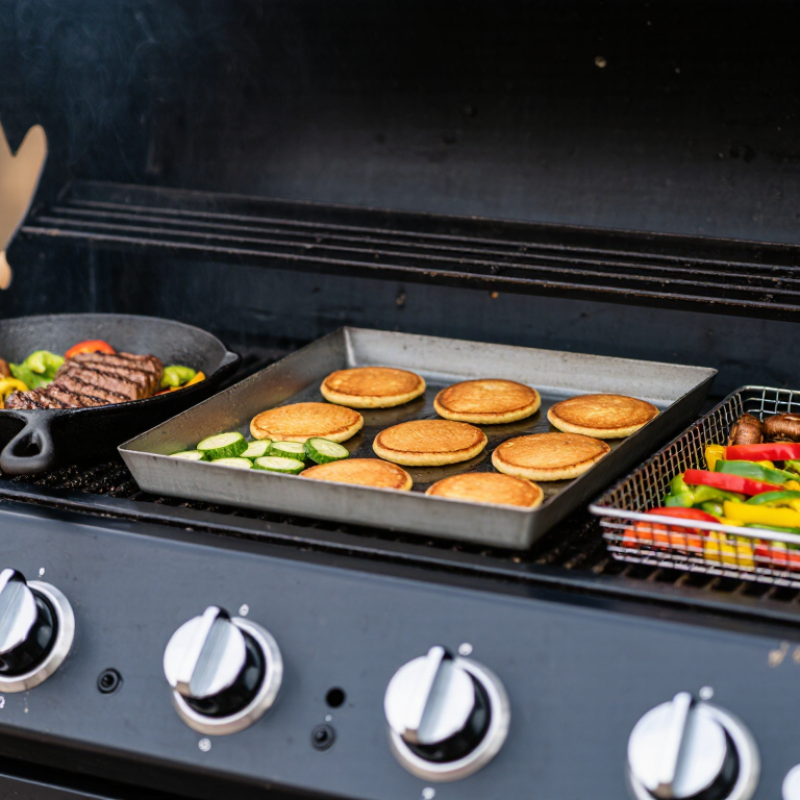
A grill griddle or flat plate creates a steady surface for foods that might slip through open grates. Think sliced mushrooms, eggs, chopped peppers, or a delicate fish fillet. Solid plates are often made from cast iron or steel. Cast iron holds heat well, while thinner steel may warm faster but cool more quickly. Choose a plate that fits your grill without blocking vents or interfering with its burners. A little space around the cookware helps heat circulate.
Flat-surface cooking also makes it easier to gather ingredients and turn them with a spatula. Preheat the plate gradually, then add a thin film of cooking oil to help prevent sticking. Heat can vary across the surface, even when the plate looks evenly warmed. That takes practice. A griddle may also deliver less direct flame flavor than open grates, which is a real trade-off for convenient cooking.
Tips: Check that the plate is designed for grill use. Keep handles away from direct flame, and use heat-resistant gloves when moving hot cookware. Avoid sudden temperature changes; they can damage some materials. Clean the plate after it cools, and follow its care instructions.
Ceramic-Coated Grill Pans for Easy Food Release
Ceramic-coated grill pans can make delicate foods easier to turn, especially when smooth fish or sliced zucchini meets hot ridges. A light film of oil helps, but the coating’s low-friction surface does much of the work. That matters. Food releases more cleanly, and browned grill marks are easier to preserve.
Grand View Research estimated the global cookware market at USD 27.7 billion in 2023. Its cookware market report projected a 6.5% compound annual growth rate from 2024 to 2030. This industry-wide figure signals a growing cookware category; it does not prove every ceramic-coated pan performs equally well. Coating thickness, pan construction, and care all affect results.
For better release, preheat gradually and cook over medium heat rather than leaving an empty pan on high. Use silicone or wooden utensils, and let the pan cool before washing. A soft sponge usually clears oil from the grooves; stubborn residue may need a short soak. Not forever. Ceramic coatings can lose their easy-release feel with wear, so check care instructions and coating details before buying. The ridges can still be fiddly to clean.
What Are the Top Grill Cookware Types in 2026? — Ceramic-Coated Grill Pans for Easy Food Release
| Cookware Type | Best For | Food Release | Heat Performance | Care and Use | Key Trade-Off |
|---|---|---|---|---|---|
| Ceramic-Coated Grill Pan | Fish, vegetables, eggs, and other foods that can stick easily | Typically easy when the coating is clean and undamaged; little or no added fat may be needed for some foods | Suitable for stovetop grilling; maximum temperature depends on the pan and its coating | Use non-metal utensils and gentle cleaning. Follow the maker’s temperature and oven-use instructions | The coating can wear or scratch over time, and high-heat tolerance varies by product |
| Cast-Iron Grill Pan | Steaks, burgers, and foods that benefit from strong searing | Improves with seasoning and regular use; food can stick if the surface is poorly seasoned or insufficiently heated | Holds heat well and can maintain a steady cooking temperature | Dry promptly after washing; maintain the seasoning layer and avoid prolonged soaking | Heavy and slow to heat; requires seasoning care |
| Enameled Cast-Iron Grill Pan | Searing and stovetop grilling without maintaining bare-iron seasoning | Non-reactive enamel offers a smooth cooking surface, but it is not necessarily nonstick | Retains heat well; gradual heating helps reduce thermal stress | Use utensils and cleaning methods recommended for the enamel; avoid sudden temperature changes | Heavy, and the enamel may chip if handled roughly |
| Stainless-Steel Grill Pan | High-heat cooking, browning, and cooks who prefer an uncoated surface | Food may stick unless the pan is properly preheated and enough cooking fat is used | Heats quickly; performance varies with the pan’s construction and thickness | Can usually be cleaned with standard cookware methods; follow care instructions for the specific pan | Requires attention to heat and timing for easier release |
| Carbon-Steel Grill Pan | High-heat searing and frequent stovetop grilling | Can develop a naturally slick seasoned surface with use; early performance depends on seasoning | Heats relatively quickly and responds readily to temperature changes | Dry after washing and maintain the seasoning to help limit rust | Needs seasoning care and may react to prolonged contact with acidic foods |
| Perforated Grill Basket | Small or delicate vegetables and bite-sized foods cooked on an outdoor grill | Openings allow heat and smoke to reach the food; a light coating of oil can help reduce sticking | Designed for use over a grill rather than as a flat stovetop pan | Use heat-resistant tools and clean food residue from the openings after cooking | Does not provide the same broad, continuous searing surface as a solid pan |
Selection tip: For ceramic-coated cookware, check the product’s stated heat limit, oven compatibility, and utensil guidance; these details vary by pan.
How to Choose Grill Cookware for Your Food and Grill Type
What Are the Top Grill Cookware Types in 2026?
Choosing grill cookware starts with the food and the heat source. HPBA’s 2024 State of the Barbecue Industry report says 70% of U.S. adults own a grill or smoker, so one setup rarely fits every cook. For thin fish fillets or sliced vegetables, use a perforated basket; it limits slipping while letting smoke reach the food. A cast-iron griddle suits eggs, smash burgers, and small pieces that might fall through the grate. On a charcoal grill, leave room for indirect heat. For a gas grill, check that the pan sits securely and does not block too much airflow. Heavy cookware holds heat well, but it can be awkward to lift when hot.
Tips: Match pan size to your grate, not just your recipe. Use a thermometer for thick cuts; USDA guidance sets 165°F for poultry and 145°F for whole cuts of beef, pork, and lamb, followed by a three-minute rest. That detail matters more than a deep sear.
Stainless steel is durable and easy to handle, though delicate foods may stick without enough oil. Cast iron gives a strong crust, but needs careful drying to prevent rust. A grill-safe nonstick pan can simplify cleanup; check its temperature limit before use. I still find baskets fiddly with small vegetables. Cut them larger, or expect a few escapes.
