10 Best Office Cabinets for Every Workspace?

Choosing an Office Cabinet is less about filling an empty corner than supporting the work that happens around it. A compact cabinet beside a desk can keep project files close. A taller unit may hold supplies, binders, and equipment without spreading clutter across the floor. Small details matter. Check door swing, shelf depth, locking options, and clearance beneath nearby desks before comparing finishes.

Architect Louis Sullivan’s famous design principle, “form follows function,” offers a useful lens for office storage. It is not a cabinet-specific recommendation, but it reminds us to start with purpose. This guide considers how cabinet size, materials, configuration, and access affect different workspaces. A shared office may need labeled shelves and secure drawers. A home workspace might benefit more from a narrow unit that fits beneath a window. Measure the room, then consider what needs storing each day.

Looks can mislead. A glossy cabinet may photograph well but show fingerprints; a sturdy-looking unit may still have shelves that sag under heavy files. Product details and user needs deserve equal attention. The best choice depends on the room, budget, and workload—not a single universal ranking. And storage can expose a bigger problem: too many supplies, or no clear filing routine. These ten options offer practical starting points, not perfect answers.
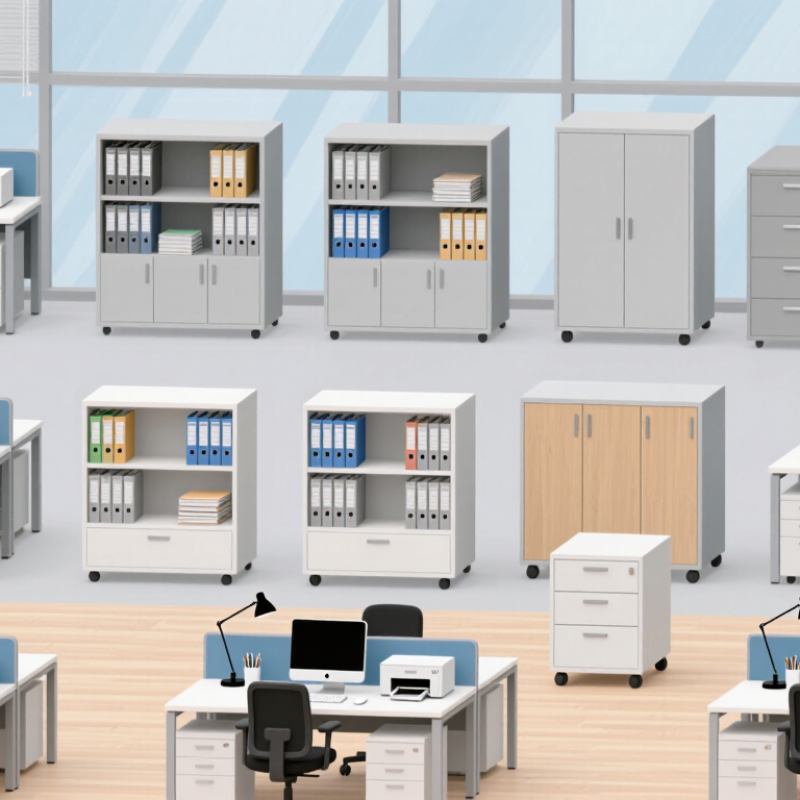
10 Best Office Cabinets for Every Workspace?

How Office Cabinets Are Classified by Storage Type and Workspace Use

Office cabinets are best classified by what they hold and where people use them. Vertical filing cabinets suit narrow offices and paper records; lateral units make frequently used folders easier to scan. Mobile pedestals keep personal supplies beside a desk, while lockable cupboards store shared equipment or sensitive files. Open shelving works for reference materials, but it can look untidy fast.

The U.S. Environmental Protection Agency’s 2018 materials report estimates that paper and paperboard made up 23.1% of municipal solid waste. That figure covers the whole waste stream, not offices alone, but it shows why document storage still deserves planning. A filing cabinet should match actual record volumes, not an imagined archive. Measure folders, drawer clearance, and walking routes before choosing a unit. Small detail. Not trivial.

Workspace use changes the choice. In a compact private office, a vertical cabinet beside the desk preserves floor space. Shared teams may benefit from labeled lateral drawers or central cupboards with clear access rules. Reception areas need closed storage for supplies, while hybrid work zones often need fewer personal drawers and more shared storage. Gensler’s 2024 Global Workplace Survey examines how workers use offices for focused work and collaboration; that distinction matters when placing cabinets. Storage should support the task without blocking circulation. I would still leave some capacity unused. Real offices change, and a perfectly full cabinet is rarely a sign of good planning.

Which Safety Tests Apply: ANSI/BIFMA X5.9 Covers Office Storage Units

A cabinet may look sturdy when empty, but daily use tells a different story. ANSI/BIFMA X5.9 is a performance standard for office storage units, including many cabinets, files, and shelving units. Its tests examine areas such as strength, stability, and durability under specified conditions. Drawers may be opened and loaded repeatedly; shelves and other components face measured forces. Small details matter. A heavily loaded drawer can shift a cabinet’s balance, especially on an uneven floor.

When comparing cabinets, ask whether the exact unit and configuration were tested to the current edition of X5.9. Test results for one size or setup may not cover another. Check the stated load limits, assembly instructions, and any anchoring guidance. The standard provides useful evidence, not a promise against every accident or misuse. It also cannot tell you whether a cabinet’s dimensions suit a narrow aisle or a crowded desk area. I have seen that overlooked more than once. Leave room for drawers to open fully, and keep heavier items low. A neat label is helpful, but the underlying test documentation is better.

Office Storage Safety: What ANSI/BIFMA X5.9 Evaluates

A scope overview of safety and performance areas addressed by applicable tests for office storage units.

Each bar marks an area addressed by the standard, not a score or pass rate. The specific procedures and requirements depend on the storage-unit type and configuration; consult the applicable edition of ANSI/BIFMA X5.9 for details.

How to Compare 10 Cabinet Types by Capacity, Materials, and Security

Office cabinets differ less by appearance than by what they must hold. Vertical filing cabinets suit narrow spaces and hanging folders, while lateral models store wider files across deeper drawers. Mobile pedestals keep daily paperwork close. Small details matter. Cupboards and bookcases with doors handle mixed supplies, but shelves need suitable weight limits. Lockers store personal items; wardrobes add room for coats and bags. Credenzas offer broad surfaces and concealed storage. Tambour cabinets save door-swing space. Fire-resistant document cabinets prioritize protection, though their usable capacity may be smaller than their exterior suggests.

Compare construction as carefully as capacity. Steel handles frequent use and can support lockable drawers; laminate-faced panels often look warmer but may chip at exposed edges. Wood cabinets can suit reception areas, yet heavy contents require sturdy shelves. Security also varies: a basic key lock may deter casual access, but it is not the same as controlled access or a tested fire rating. Check drawer dimensions, shelf adjustability, lock type, and anchoring guidance before buying. Measure the doorway, too. A cabinet that fits the wall may not fit through the entrance. I would avoid choosing by advertised capacity alone; folder sizes and awkward supplies can make a large cabinet feel cramped. That is an easy mistake.

How to Plan Cabinet Layouts Around the ADA’s 36-Inch Accessible Route

A cabinet layout should protect a continuous accessible route, not just look spacious on a floor plan. The ADA Standards generally call for an accessible route at least 36 inches wide. Measure the narrowest clear point between finished surfaces, cabinet pulls, and nearby furniture. A few inches can disappear quickly.

Map the route from the office entrance to shared work areas, storage, and other destinations. Use painter’s tape to mark the proposed cabinet edges on the floor, then check the clear width with a tape measure. Open doors and drawers during the test. They can block a route that seemed clear when everything was closed. Leave room for people to approach frequently used shelves without forcing others to squeeze past.

A plan can still miss real-life habits. Someone may park a cart beside a cabinet or leave a chair pulled out. Test the layout with those everyday obstacles in place. Avoid placing deep cabinets at tight turns, and keep handles from projecting into the walking path. If the available space is limited, consult an accessibility professional or the relevant building authority before installation. A drawing is useful, but it cannot reveal every pinch point.

How to Match Cabinet Features to Team Size, Workflow, and Budget

Cabinet planning should begin with people and tasks, not a catalogue. Gensler’s 2024 Global Workplace Survey found employees in high-performing workplaces were 2.5 times more likely to say their workplace supported productivity. Storage is only one factor, but poor access can interrupt focused work. A six-person team sharing paper files may need labeled, lockable drawers near its printer. A hybrid group may benefit more from personal cubbies and fewer bulky cabinets. Small detail. Check who needs access before choosing locks.

Match capacity to workflow. Shared project materials call for wide shelves and clear labels; confidential records need controlled access. Measure the room, door swings, and walking paths before ordering. For growing teams, modular units can add capacity without replacing everything. For tighter budgets, compare total ownership costs, including installation, repairs, and usable lifespan—not just the sticker price. CBRE’s workplace research tracks changing office use, a reminder that headcount alone may not predict how often storage is accessed. I would avoid buying extra capacity “just in case”; that guess can consume floor space and budget. Still, forecasts are imperfect. Pilot one cabinet layout for a few weeks, then adjust based on what staff actually store and retrieve.

10 Best Office Cabinets for Every Workspace? — How to Match Cabinet Features to Team Size, Workflow, and Budget
Cabinet type Approx. dimensions (W × D × H) Typical storage Best fit by team size Workflow match Useful features Indicative budget (USD)
Two-drawer vertical file cabinet 15 × 18 × 29 in About 2 file drawers; suitable for personal or departmental files 1–5 people Low-volume filing near an individual desk Locking drawers; compact footprint; letter or legal file support $100–$300
Four-drawer vertical file cabinet 15 × 18 × 52 in About 4 file drawers; organized by year, client, or project 3–12 people Frequent retrieval of paper records in a small office Full-extension drawers; anti-tip interlock; central lock $180–$500
Two-drawer lateral file cabinet 36 × 20 × 29 in Two wide drawers for side-by-side file categories 3–15 people Shared filing and quick access to active documents Wide top can double as a work surface; drawer dividers; lock $250–$700
Three-drawer lateral file cabinet 36 × 20 × 40 in Three wide drawers for larger shared archives 8–25 people Centralized filing for teams with regular paper workflows Label holders; anti-tip design; adjustable file rails $350–$900
Mobile under-desk pedestal 16 × 20 × 25 in Two or three drawers for supplies and everyday documents 1–8 people Flexible desks, shared workstations, and hybrid offices Locking casters; personal lock; slim profile $100–$350
Open shelving cabinet 30 × 15 × 72 in Multiple shelves for binders, reference books, and labeled bins 3–20 people Frequently used materials that need to remain visible Adjustable shelves; optional wall anchoring; fast access $150–$600
Closed-door storage cabinet 36 × 18 × 72 in Adjustable shelves for supplies, equipment, or boxed records 5–30 people Shared supply storage where a tidy appearance matters Lockable doors; adjustable shelves; concealed contents $250–$900
Wardrobe and coat cabinet 24 × 24 × 72 in Hanging space plus a shelf for bags or personal items 5–25 people Offices with visitors, uniforms, or limited coat-closet space Hanging rail; upper shelf; ventilated options $250–$800
Modular credenza cabinet 60 × 20 × 30 in Combination of drawers, shelves, and concealed storage 5–30 people Meeting rooms and shared spaces needing both storage and a counter Mix-and-match modules; cable pass-through; broad work surface $500–$1,800
Fire-resistant file cabinet 22 × 22 × 28 in Limited capacity for priority paper records and documents Any team with essential paper records Long-term protection of critical documents; not a substitute for backups Tested fire-resistance rating; secure lock; heavy construction $500–$2,000+

Dimensions and storage capacities are approximate and vary by model. Budget ranges are indicative per cabinet in USD; materials, security ratings, delivery, and local market conditions can change the final cost.