
Best Interactive Light Sculpture Suppliers in 2026
An Interactive Light Sculpture transforms a space into an experience that responds to people. A visitor approaches; colors shift, shadows stretch, and patterns ripple across the floor. The effect feels immediate. Yet dependable results begin long before installation day.
Light artist James Turrell has said, “Light is not so much something that reveals, as it is itself the revelation.” His observation captures why these works demand more than bright fixtures. Suppliers must bring together responsive sensors, carefully calibrated lighting, durable materials, and software that behaves consistently. A beautiful render is not enough. Buyers should ask how the system performs under changing daylight, crowd movement, and long operating hours. They should also review maintenance needs, installation support, accessibility, and project references.
This guide to the Best Interactive Light Sculpture Suppliers in 2026 focuses on those practical questions. It considers creative capability alongside engineering, customization, delivery, and after-sales service. Supplier strengths vary, and a showcase installation may not predict performance in every venue. That deserves scrutiny. Even a detailed brief cannot remove every uncertainty; on-site testing still matters. The aim is not to declare one universal winner, but to help buyers compare providers against real project needs, from a quiet gallery threshold to a busy civic plaza.
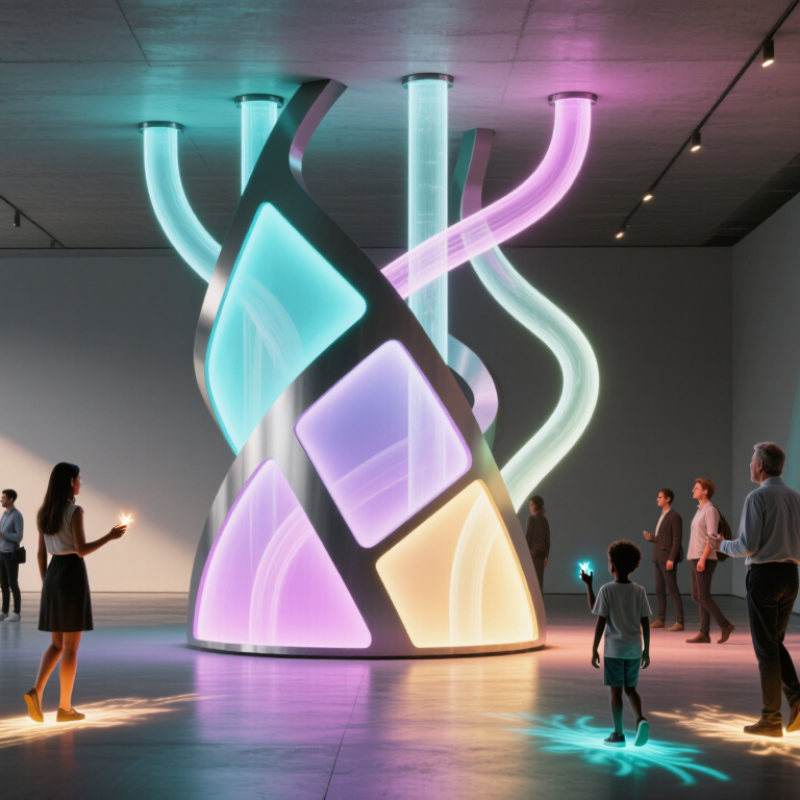
Interactive Light Sculpture Suppliers: Roles, Products, and Applications
Interactive light sculpture suppliers do more than deliver illuminated objects. They help translate a site’s dimensions, visitor flow, and operating conditions into a workable installation. Their teams may provide concept sketches, lighting components, sensors, control software, structural supports, and commissioning. Some also coordinate fabrication and on-site testing. Details matter. A pressure-sensitive floor piece needs clear sensor zones, safe cable routing, and brightness that remains readable in daylight. A responsive wall sculpture may use proximity sensors, addressable LEDs, and programmed color transitions to invite movement without overwhelming nearby exhibits. Experienced suppliers explain these choices clearly and document maintenance needs, power loads, and access for replacements.
Applications include museums, public plazas, hotels, retail spaces, festivals, and learning environments. Context matters. A museum may prioritize quiet interaction and low glare, while a plaza needs weather-resistant enclosures and controls for extended operating hours. When interaction is central, suppliers should offer sample sequences or a working mock-up. Ask how the sculpture behaves when sensors miss a visitor, software restarts, or a light module fails. Often skipped. A portfolio can show visual skill, but it cannot prove every installation will perform identically. Site checks, realistic testing, and clear handover notes reduce uncertainty. Still, even a careful plan may need adjustment after visitors arrive.
DMX512 Control: 512 Data Slots per Universe
For interactive light sculpture suppliers in 2026, ask how each fixture uses a DMX512 universe before comparing quoted channel counts. ANSI E1.11, the DMX512-A standard maintained through ESTA’s Technical Standards Program, defines a packet with up to 512 data slots. Each slot carries an 8-bit value, from 0 to 255. That is the limit. A sculpture with 120 RGB pixels may need 360 slots before adding dimmers, sensors, or movement controls. A single universe can fill quickly.
Request a channel map and a live demonstration, not just a fixture list. Watch a test sequence: one pixel changes color, nearby pixels respond, and the rest stay still. Ask whether the controller sends sensor input through a separate system; DMX512 itself is a control protocol, not a sensor network. Suppliers should explain their addressing plan, refresh behavior, and what happens when a data line is interrupted. These details matter on a large installation. This sounds tidy on paper, but cable routing and last-minute fixture changes can make channel plans messy. I would leave spare slots where possible and verify the full setup under show conditions before installation.
Outdoor Durability: IP65 Dust-Tight and Water-Jet Protection
Interactive light sculptures face rain, windblown grit, and repeated cleaning. Outdoor durability starts with the enclosure, but also depends on sealed cable entries, protected connectors, and well-fitted access panels. A tiny gasket gap can matter. So can water collecting around a base after a storm.
IEC 60529, the international enclosure-protection standard, defines IP65 as dust-tight protection plus resistance to water jets.
Its IPX5 test uses a 6.3 mm nozzle delivering 12.5 litres per minute at about 30 kPa. The jet is applied from roughly 2.5 to 3 metres away. Testing lasts at least three minutes, or one minute per square metre of enclosure surface, whichever is longer. These figures describe a controlled test, not every outdoor condition.
For suppliers, ask for test documentation covering the complete assembled sculpture, including joints and cable glands—not just the lighting module. Check that seals remain accessible for inspection, and confirm materials suit local UV exposure, temperature swings, and coastal air. IP65 does not mean submersible or corrosion-proof. That distinction is easy to overlook. A specification can look reassuring on paper, yet installation details still deserve scrutiny.
LED Reliability: LM-80 Testing and TM-21 Lumen-Maintenance Projections
For an interactive light sculpture, LED reliability is more than a bright first impression. LM-80 reports track lumen maintenance for LED packages, modules, or light engines under controlled conditions. Ask suppliers for the test report, operating temperature, and test duration. Check that the tested component matches the one proposed for the sculpture. Small differences matter.
TM-21 uses LM-80 data to estimate future lumen maintenance. It is a projection, not a promise. Its limits depend on the available test hours and the applicable calculation method. A supplier should explain the assumptions behind any stated lifetime, rather than presenting a single number without context. Look closely.
Real sculptures face changing conditions. LEDs may sit behind diffusers, run in tight enclosures, or pulse during interactive sequences. Heat can build near a compact driver. LM-80 testing does not reproduce every installation detail, and TM-21 does not predict every failure mode. Ask how the supplier assessed thermal behavior in the actual fixture design, and whether testing covered expected dimming and operating patterns. One question is easy to miss: will color remain consistent as output declines? A clear answer, supported by test records and practical thermal checks, is more useful than an impressive lifetime claim. Even then, uncertainty remains. That deserves an honest conversation.
Supplier Comparison: Control, Safety, Installation, and Lifecycle Costs
A supplier comparison should begin with control, not the sculpture’s render. Ask for a working demo of dimming, sensor response, emergency stop, and offline behavior. Confirm whether the system uses DMX or another documented protocol, and request a wiring diagram before pricing. The U.S. Department of Energy’s Energy Saver guidance says LEDs use at least 75% less energy and can last up to 25 times longer than incandescent lighting. That comparison is useful, but it does not predict a sculpture’s service life: heat, drivers, and daily operating hours matter.
Safety and installation details can change the real cost. Request electrical test documentation, enclosure ratings, cable routes, and a written commissioning plan. Check who supplies lifts, power connections, and replacement parts. A low quote may omit these. For lifecycle estimates, compare energy use, labor, spare drivers, software support, and expected downtime over the same period. Ask suppliers to state assumptions clearly; small assumptions can distort the total.
Tips: Test one scene in the actual space before full installation. Watch for glare on nearby glass, hot spots on the floor, and slow sensor response. Request a maintenance schedule and a list of replaceable parts. Keep a little doubt: projected lifetimes are estimates, not guarantees.
Interactive Light Sculpture Suppliers: Outdoor Enclosure Benchmark
IEC 60529 water-jet test flow rates provide one comparable check for installations exposed to rain or washdown. Ask suppliers for the exact IP rating and test documentation for the proposed assembly.
IPX5 uses a 6.3 mm nozzle at 12.5 L/min; IPX6 uses a 12.5 mm nozzle at 100 L/min. Water-ingress ratings do not establish control-system compatibility, electrical safety, UV or corrosion resistance, installation effort, or lifecycle cost—compare those separately for each project.
