
10 Best Hotel Main Entrance Doors for 2026?
A hotel entrance does more than frame a lobby. It handles luggage, weather, daily traffic, and the first impression guests carry inside. For 2026, choosing a Hotel Main Entrance Door means balancing appearance with reliable operation, accessibility, security, maintenance, and energy performance. A dramatic pivot door may suit a design-led property, while a busy airport hotel may need automatic sliding doors that keep arrivals moving. Context matters.
Energy performance deserves careful attention, but claims should stay proportionate. The 2023 Global Status Report for Buildings and Construction, published by UNEP and GlobalABC, estimates that buildings and construction accounted for 34% of global energy demand and 37% of energy- and process-related CO₂ emissions in 2022. Those figures describe the whole sector, not the savings from one entrance. Still, they make air leakage, glazing, and door seals worth checking during specification.
Guest experience is another useful lens. J.D. Power’s 2024 North America Hotel Guest Satisfaction Index Study reported an average satisfaction score of 677 out of 1,000. That score does not prove that entrance doors drive satisfaction; it does remind operators that every touchpoint contributes to a stay. Small details count. A slow closer, a fingerprinted handle, or a threshold that catches a suitcase can undermine an otherwise polished arrival. The selections ahead compare ten entrance-door types by design, durability, operating needs, and practical trade-offs. No door is perfect. The right choice depends on the building, climate, traffic, and maintenance capacity—not a trend alone.
What Defines a Hotel Main Entrance Door in 2026?
A hotel main entrance door in 2026 is more than a grand façade. It must handle rolling luggage, wheelchairs, delivery carts, and a steady flow of guests without creating a bottleneck. Clear sightlines help visitors recognize the entrance, while well-positioned lighting makes the threshold easier to read at night. Small details count.
The door should balance easy operation with controlled access. Automatic sensors need to detect people approaching from different angles, including children and guests moving slowly. Security features should support staff oversight without making arrivals feel tense. A door that opens smoothly in a demonstration may behave differently during a rainy rush, so real-world testing matters.
Material choice affects both appearance and upkeep. Durable finishes can withstand fingerprints, cart impacts, and frequent cleaning, but even strong materials need inspection. Seals, hinges, closers, and sensors can drift out of adjustment. That matters. Energy performance also depends on the whole entrance: gaps, vestibule layout, and how long doors remain open all influence drafts and indoor comfort. There is no single ideal design; climate, building layout, and guest traffic should shape the specification.
Key Criteria for Comparing Hotel Entrance Doors
Comparing hotel entrance doors starts with arrival patterns, not appearance alone. A lobby serving tour groups needs different opening width and operating speed than a quiet, small property. Watch the threshold during busy check-in: rolling suitcases, strollers, and wet shoes expose awkward transitions quickly. Smooth passage matters.
Assess thermal and acoustic performance in the actual setting. A door facing a windy street may need stronger weather seals or a vestibule; an urban property may prioritize reducing traffic noise. Request documented air-leakage, insulation, and acoustic data, then compare test conditions with the building’s climate and use. Numbers without context can mislead.
Safety and upkeep deserve equal weight. Check clear sightlines through glazing, reliable access control, emergency-egress compatibility, and hardware staff can operate during a rush. Confirm accessible clear width and threshold height against applicable local requirements. Inspect hinges, closers, seals, and finish samples; salt, grit, and frequent cleaning can change maintenance needs. A beautiful entrance can still be tiring to service. Leave room for uncertainty: site exposure and staff habits may matter more than a catalog rating.
Ten Leading Hotel Main Entrance Door Designs for 2026
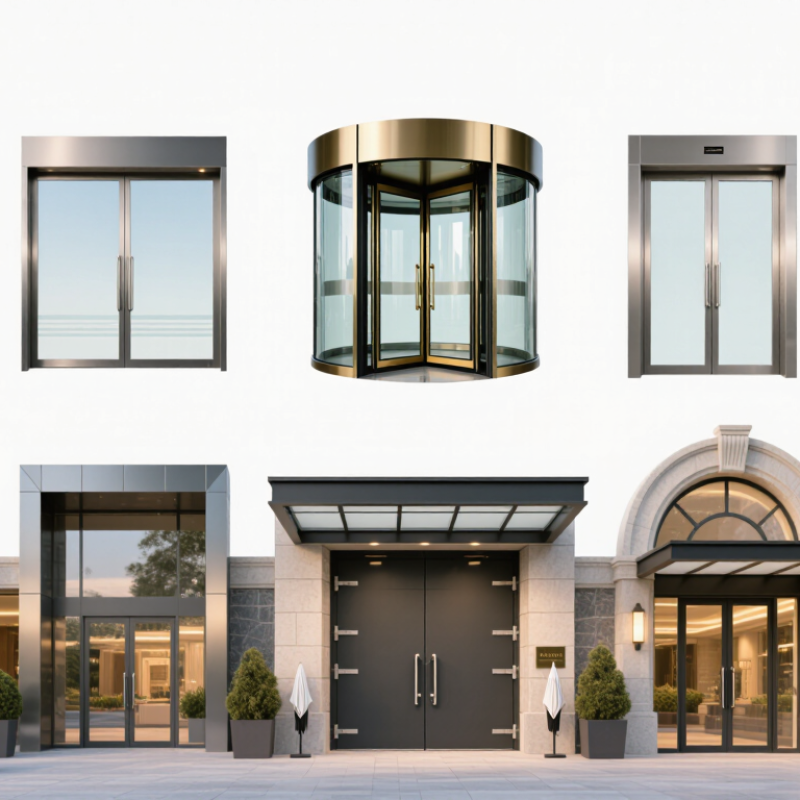
For 2026, ten hotel main entrance door designs stand out for their balance of welcome, durability, and visual character. Tall clear-glass doors create an open arrival, while bronze-framed glass adds warmth. Solid timber offers a tactile, quieter impression. Revolving doors manage busy traffic, but need careful placement. Oversized pivot doors make a bold statement. Arched entrances soften modern façades. Sliding glass doors save space. Stone-framed doors feel grounded and permanent. Perforated metal screens filter sunlight. Mixed-material designs pair wood, glass, and metal for a distinctive entrance.
Looks are only part of the decision. A door should suit the lobby’s traffic, local weather, and maintenance capacity. Coastal air, for example, can wear down some finishes faster than expected. Glass may brighten the entrance, yet it can also reveal fingerprints throughout the day. Consider clear sightlines, comfortable access, and smooth movement for guests carrying luggage. A striking entrance can still disappoint if the door feels awkward to use.
Tips: Test a full-size mock-up if possible. Check how the entrance sounds and feels during a busy arrival period. Small details matter. A beautiful handle placed too high can make the welcome feel less natural.
10 Hotel Main Entrance Door Designs for 2026
Typical number of movable door leaves in each entrance configuration
These are representative configurations, not a ranking or building-code requirements. Panel counts vary by product and project; confirm accessibility, safety, and local code requirements during design.
How Materials and Door Systems Differ
A hotel entrance is more than a visual feature; it handles luggage, crowds, weather, and constant use. Glass doors create an open, bright arrival, while aluminum frames are relatively light and resist corrosion. Steel can provide a sturdy frame, but its finish and upkeep matter, especially near coastal air. Wood brings warmth, though exposure to moisture and frequent contact may mean more maintenance.
The operating system changes how the entrance feels. Hinged doors are familiar and straightforward, but a busy lobby can make them awkward for guests carrying bags. Sliding doors save swing space and can open automatically when sensors detect approaching visitors. Check sensor timing and the clear opening during real traffic, not just on a drawing. Small details matter.
Revolving doors can help limit drafts and preserve indoor comfort, yet they may be difficult for some guests to use. A nearby hinged or sliding route can offer a more practical choice. It depends. Vestibules add another layer between outdoors and the lobby, though they need enough room for queues and mobility devices. I would compare noise, maintenance access, climate, and peak-hour flow before choosing. Honestly, appearance is easy to judge; daily operation is less obvious. A trial walk-through with luggage can expose issues that a specification sheet misses.
10 Best Hotel Main Entrance Doors for 2026? - How Materials and Door Systems Differ
| Entrance Option | Typical Materials | How the System Works | Best Suited To | Key Advantages | Important Considerations |
|---|---|---|---|---|---|
| 1. Automatic sliding glass doors | Tempered or laminated safety glass, commonly in aluminum framing | One or more panels slide horizontally using a powered operator and presence sensors. | Busy, accessible entrances with frequent two-way pedestrian traffic | Hands-free access; wide clear openings are possible; glass admits daylight and provides visibility. | Requires suitable sensor coverage, regular operator maintenance, and a clear path for emergency egress. Wind exposure and entrance air leakage need consideration. |
| 2. Automatic swing doors | Framed glass, aluminum, steel, or wood door leaves | A powered operator opens a hinged door when activated by a sensor, push plate, or access-control signal. | Entrances with limited space for sliding panels or an existing hinged-door layout | Can improve accessibility while retaining a familiar swing-door appearance; can be integrated with controlled access. | Needs adequate swing clearance and protection from impact. Opening force, closing speed, and egress operation must meet applicable requirements. |
| 3. Revolving doors | Curved glass wings and enclosure panels, typically with metal framing | Multiple wings rotate around a central shaft within a circular enclosure; some systems also include a separate swing door. | Large hotels with steady pedestrian flow and a need to limit drafts at the entrance | Supports continuous circulation and can reduce direct exchange of indoor and outdoor air compared with an open doorway. | Needs careful planning for accessible entry, luggage, groups, and emergency egress. A compliant adjacent door or other approved egress provision may be required by local code. |
| 4. Manual sliding glass doors | Safety glass with aluminum or other suitable metal framing | Panels move horizontally by hand along tracks, usually with fixed sidelights. | Lower-traffic entrances where powered operation is not necessary | Provides a broad glazed opening with a relatively simple operating system and no powered door operator. | Track cleanliness and smooth operation matter. The clear opening, handle arrangement, and operating effort should suit accessibility and egress needs. |
| 5. Thermally broken aluminum-framed glass doors | Aluminum frame with a thermal break; insulated glass may be used | Hinged or sliding door leaves sit within a glazed storefront or entrance framing system. | Contemporary façades requiring substantial glazing and a durable, relatively lightweight frame | Aluminum is corrosion-resistant in many environments and allows slender framing; thermal breaks can reduce heat transfer through the frame. | Performance depends on the complete assembly, including glazing, seals, thresholds, and installation. Metal frames may still conduct heat, and finishes need maintenance. |
| 6. Insulated steel entrance doors | Steel skins over an insulated core, with a steel frame and protective finish | Usually a hinged system; may be paired with glazed sidelights, an automatic operator, or access control. | Service entrances, secure areas, or locations where a robust opaque door is preferred | Can provide a strong, durable door leaf and accommodate a range of hardware and access-control components. | Can be heavy and may dent or corrode if the finish is damaged. Weather resistance, insulation, and any required fire rating depend on the tested door assembly. |
| 7. Solid wood entrance doors | Exterior-grade solid wood or engineered wood construction with a weather-resistant finish | Typically hinged, with heavy-duty pivots or hinges and optional powered operation. | Hotels seeking a warm, traditional, or distinctive entrance appearance | Offers a natural material character and can be refinished; suits designs where an opaque, substantial door is desired. | Wood can expand, contract, or weather with changes in moisture and temperature. Requires appropriate sealing, maintenance, and protection from direct exposure. |
| 8. Framed laminated-glass doors | Laminated safety glass with metal framing and compatible door hardware | Usually installed as hinged leaves in a framed entrance system; configuration may be manual or automated. | Entrances where visibility and daylight are priorities and a safety-glazing specification is required | Laminated glass is made with an interlayer that helps hold fragments together if the glass breaks; clear glazing maintains sightlines. | Glass type and thickness must be selected for the location and design loads. Glazing alone does not determine security, acoustic, or energy performance. |
| 9. Bronze-clad or architectural metal doors | Metal-clad door leaves over a suitable core, with matching architectural metal framing or trims | Commonly hinged, with manual or powered operation depending on traffic and accessibility needs. | Premium entrances where a distinctive metal finish is part of the architectural design | Can create a durable, refined appearance and coordinate with other façade details. | Cost, weight, finish variation, and specialist fabrication should be evaluated. Specify the core, frame, hardware, and finish as a complete assembly. |
| 10. Air-lock vestibule with paired doors | Usually glazed aluminum-framed or metal doors, with an enclosed vestibule between exterior and interior doors | Two separate door sets form a small entry chamber; doors may be manual or automatic and can be sequenced where appropriate. | Hotels in climates where drafts, temperature changes, or wind-driven rain are concerns | The vestibule creates a transition space and can help limit direct exposure of the lobby to outdoor conditions. | Requires enough floor area and accessible maneuvering space. Door sequencing, alarms, and egress must be designed to comply with local requirements. |
Selection note: The most suitable entrance depends on traffic volume, climate, accessibility, security, maintenance, façade design, and local building and fire codes. Verify performance ratings and egress requirements for the complete door assembly with the project design team and local authorities.
How to Match an Entrance Door to a Hotel’s Needs
A hotel entrance door should fit the way guests actually arrive, not just the look of the lobby. A city property may face constant foot traffic, rain, and street noise. A resort may need broad openings for luggage carts and a clear view of gardens. Watch the entrance during a busy check-in period. Where do queues form? Does a suitcase catch on the threshold? Small observations often reveal more than a floor plan.
Consider access, climate, and daily upkeep together. Automatic operation can help guests carrying bags, but sensors and moving parts need regular attention. Glazed panels bring daylight into a dim vestibule and help staff see approaching visitors. They can also make heat control harder in exposed locations. Noise matters. Ask how the door, seals, and frame perform as a complete assembly, rather than judging the panel alone. Check the threshold, too; even a small lip can slow a wheeled case.
Appearance still counts, but it should support the hotel’s character without making routine maintenance difficult. A coastal entrance may need finishes that tolerate damp air and frequent cleaning. A historic property may benefit from a restrained design that suits its façade. There is no perfect door. Sometimes the visually striking option is less practical, and that trade-off deserves a second look. Compare expected traffic, cleaning routines, service access, and replacement needs before settling on a specification.
